58. Ubuntu: Culture or Computer
In 2004, South African business man, Mark Shuttelworth, released a computer operating
system which he called, ‘Ubuntu’. It is distributed by his UK-based company, Canonical
Limited, as free and open source software. Canonical creates revenue by selling technical
support and services for Ubuntu, while the operating system itself is offered free.
The word, ‘Ubuntu’, has its origin in the Bantu languages of southern Africa. Archbishop
Desmond Tutu has explained Ubuntu in these terms:
‘One of the sayings in our country is Ubuntu - the essence of being human. Ubuntu speaks
particularly about the fact that you can't exist as a human being in isolation. It speaks about
our interconnectedness. You can't be human all by yourself, and when you have this quality -
Ubuntu - you are known for your generosity.’
Maybe Shuttleworth wanted to capitalise on this notion of generosity. Yet, as I come
across many poor but happy children in Africa, I think it would be a great pity – and
unfortunate irony - if they were to come to think of Ubuntu as a computing term. I value
the capacity computers give to communicate but the same computers also have the
capacity to isolate and interefere with human interaction. Computer communication is far
short of the rich notion of interconnectedness that Archbishop Tutu is describing.
Elsewhere Tutu wrote:
‘A person with Ubuntu is open and available to others, affirming of others, does not feel
threatened that others are able and good, for he or she has a proper self-assurance that comes
from knowing that he or she belongs in a greater whole and is diminished when others are
humiliated or diminished, when others are tortured or oppressed. We think of ourselves far too
frequently as just individuals, separated from one another, whereas we are connected and
what we do affects the whole world.’
Another author, Gbowee, describes Ubuntu in these terms: ‘I am what I am because of who
we all are.’. What stands out in Africa is the security and happiness people seem to feel
within their own tribal group. I wish strongly for a more united South Sudan but not at
the expense of losing Ubuntu.
Ubuntu does not mean that people should not enrich themselves but rather, if they do,
their enrichment should also assist the community around them to improve. Many people
experience Ubuntu in the Church in Southern Sudan, an interconnectedness and concern
for the good of all in the community. I experience Ubuntu as a member of my religious
congregation and also as a member of Solidarity with Southern Sudan. The children of
Southern Sudan grow up experiencing Ubuntu in their families and local community.
We have just finished our annual gathering in Wau where there were evident aspects of
Ubuntu – our team members being open and available, affirming, belonging to a greater
whole. I surmise, something akin to Ubuntu probably existed in Europe in feudal times but
was diminished and even lost as societies became increasingly industrialised and
commercialised. Unfortunately, the personal accumulation of wealth – too often at the
expense of others – may have supplanted Ubuntu.
During our gathering we had a delightful outing to Bussera, about 30kms from Wau,
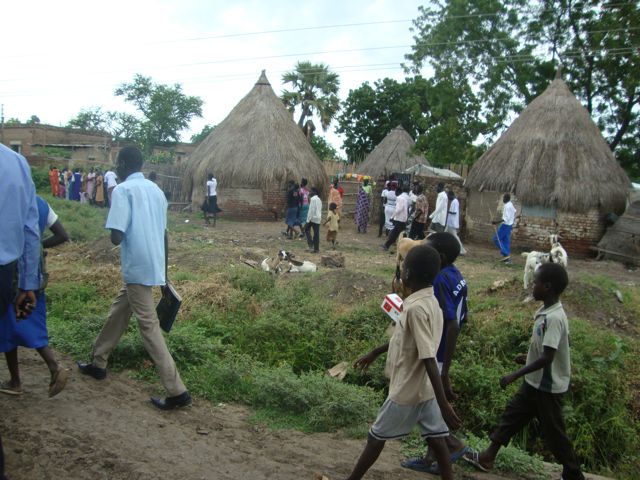
where there was once a thriving mission centre and seminary. In this rural situation, the
lifestyle is not grand and may present a first impression of decay. Yet I sensed there is
happiness, not from what people now have but from who they are and what they share as
part of their community. They are made stronger by Ubuntu. They sit together, fish
together and are together. As the African proverb says: ʻA single straw of a broom can be
broken easily, but the straws together are not easily broken.’ Finding a way to keep the straws in
the various African states together is the real problem. - Br Bill
Friday, January 7, 2011

57. Plotting Our Path - By Br. Bill Firman
57. Plotting Our Path
Over the past few months our management team in Southern Sudan has worked together to produce a draft Strategic Plan for the consideration of the Solidarity with Southern Sudan Board that meets in Rome next month. The Plan is as comprehensive as we can make it and, although written with conciseness in mind, covers some 40 pages plus another 27 pages of Appendices. Yet given the unpredictability we face in Southern Sudan, I think maybe we need a different word to describe this document – maybe a ‘chart’ or a ‘plot’. I’ll settle for the word ‘plot’ but minus most of the sinister overtones this word might suggest.
To me the word ’plan’ suggests a reasonable confidence in how and where we are going to achieve our gaols in orderly fashion. The uncertainties here, however, are abundant and it almost seems an overstatement to call it a ‘plan’. Rather we are attempting to plot our way through a minefield of possibilities beyond our control.
This is a country of developing infrastructure where government ‘forward planning’ is commonly no more than last minute planning. It has just been announced that registrations for the referendum will be extended for another week and there will be extra public holidays to make it easier for officials to register. Late changes of this kind are common in Southern Sudan. There is usually minimum prior notice and key calendar events affecting us such school dates are simply not announced well in advance.
There is no postal service in Southern Sudan other than a central post office box. There are very few street names and no street numbers. This also can be a problem, so I discovered, when applying for a new passport. The passport application form requires one to give an address, not a post office box! Further in first world countries the documents used to establish personal identity are credit cards, social security cards, health care card and bills for utilities showing house address. Here there is almost no use of such cards and services are normally ‘purchased’ in advance by buying credit for pre-payment meters. Utility invoices and receipts usually don’t have addresses.
Shopping is an exercise in grasping occasional opportunity. If you see what you want buy it now, plus any reserves you may need, as the item may not be there when you come back. So we move ahead, not by striding forward resolutely on firm ground, but by placing one foot tentatively before the other seeking firm ground on which to progress. The reality in Southern Sudan at present is that plotting a path around confronting obstacles cannot be ignored even as we seek to attain more distant goals. Yes it is important to set goals and know what we want to achieve but it would be stupidity to be so focussed on delivery of outcomes and meeting targets that we ignore the more immediate pitfalls. Sudan is littered with unfinished projects such as partly-constructed buildings, owing to the failure to accommodate the local reality.
The practice in Southern Sudan is that someone who is purchasing a product or a service may be asked to pay a large percentage upfront. Experience confirms that there is huge risk in this. Some nearby Church buildings have no roofs. The contractor was paid to finish the building but he simply disappeared with the money. I believe there is a large half-built school that has suffered the same fate at the hands of this contractor.
One builder, who is doing very good work for us, completed several government construction project months ago. He has not been paid. He has signed contracts but the existing infrastructure is not effective in bringing about justice. What is more effective is graft and other forms of corruption and that is a problem for those of us who try to act justly. This is a place where plotters are, for the moment, more effective than planners! It is something we must try to change but we ignore the current reality to our peril. Hence, as I once heard a professor say, ‘we tiptoe into the future on the brittle egg shells of the past’. My strategic plan is to head in the right direction, but carefully! - Br Bill
56. Choosing Wisely - By Br. Bill Firman
56. Choosing Wisely
Now that voter registration for the referendum has begun, there is an increasing air of expectancy in Southern Sudan. There is a large, ongoing exit of Southern Sudanese returning from the north to the south. Outside our parish church in Malakal, buses from Khatoum pull up periodically and tables have been set up to take the names and details of people returning from the north.
There is still no diesel available for sale in Malakal and many taxis have now ceased running as petrol supplies have also dried up – and thus the livelihoods of the taxi drivers. I don’t know how the buses get back to the north. Will this be a temporary shortage or is this a long-term strategy to unsettle a population that has been relatively calm? We don’t know. There is no doubt that the people of the south want peaceful secession but how this will be achieved is uncertain.
Last Sunday we celebrated the patron feast of the parish, ‘Christ the King’. The Apostolic Administrator of the diocese preached vigorously urging full participation in the referendum. The mass was advertised to start at 9:00. One had to arrive close to that time to secure a seat in the shade but it was 10 to 10 before the celebration actually began and well after midday when it concluded.
The Sudanese celebrate liturgy well and obviously enjoy their participation. The young liturgical dancers display both grace and vigour – and stamina! The choir loves to sing each antiphon twice between each verse, making the hymns very long but the rhythm of the drums and other instruments carries everyone along. No-one complains. After all, we are here to celebrate life as Sudanese Christians. All age groups seem well represented.
The very young children show remarkable patience and perseverance. There are many children but to witness one crying is rare. All adults seem to expect and get respect from the young people with little effort. A simple sign of ‘No’ is accepted without argument. The splendidly arrayed ‘mommas’ exercise a well-practised collective control. The children are compliant and seem to model clear expectations of behaviour to each other.
I guess the parents here still have control at the family hearth. Brother Damien commented perceptively, many years ago: ‘Many parents lost control the day TV entered their living room’. How much more access to outside influence do computers and the internet now bring – and by how much is the gentle modelling and guiding of parents diluted and distorted?
We cannot be modern day ‘luddites’ but can we learn from this society that guidance and restraint still has a place? Can a new Sudan emerge where the traditional values that maintain good order are preserved? For the returning Sudanese from the north, where access to first world commodities was undoubtedly greater, how difficult will their re-integration be and what values will they bring into Southern Sudanese society? The so-called ‘transition period’ after the referendum will be very important indeed.
Several people have expressed the fear that the general expectations of what will happen after secession, if it occurs, are far too utopian. Secession is not a panacea. It won’t bring immediate improvement to lifestyle but more likely a period of shortages. What will be needed is a willingness to share and compromise. Attempts at selfish exploitation are likely. So we pray for strong leadership from among the Sudanese who will begin shaping their known destiny.
We continue to count off the 101 days of prayer for peace and invite you to do the same.
- Br Bill
Wednesday, November 17, 2010
55. A Candle Flame - By Br. Bill Firman
55. A Candle Flame

Pointed

Naomi and Sara

Juba Children

Father Alberto, Construction Supervisor

Brothers from Australia

Sister Betty & student teachers
It is six days now since we have had town power. The referendum may be two months away but already there are shortages beginning to occur in Malakal. No service station is selling diesel. So we can only run our generator for short periods. As I type, I am sitting in my room with a candle flickering in the background. Just a little light but it makes all the difference. The candle gives light but it also warms the darkness – not literally but metaphorically. Candle light is cosy light; candle light brings comfort; a candle flame is a powerful symbol of hope and a future.
What was it George Bernard Shaw stated so graphically?
"I want to be thoroughly used up when I die, for the harder I work the more I live. I rejoice in life for its sake. Life is no brief candle to me. It is a sort of splendid torch which I've got hold of for the moment and I want to make it burn as brightly as possible before handing it on to the next generation."
Yes life is a splendid torch, an opportunity to burn brightly, to make a contribution, to make a difference – for the better. Life does not last forever. Like the burning candle we are consumed. We are all consumed in death. The real issue is what do we do when we are alive? What will we pass on to the next generation?
Elsewhere the irascible Shaw wrote:
“Life is a flame that is always burning itself out, but it catches fire again every time a child is born.”
Shaw is also the poet, the conveyor of vivid, verbal imagery. ‘A child is born’. Jesus is born in Bethlehem and God is among his people. There are many children in Sudan. They are the future of this country. The people of Southern Sudan may be poor economically but they are rich in family life and optimistic for their future. They see light after the darkness of war. Many express an overt faith in Jesus who said ‘I am the way the truth and the light’. (John 14:6)
Jesus is the light that encourages them in their joyful celebrations of mass. God is revealed in their faith, gratitude and good will to those of us who have come to live with them. Here it is normally good to be seen as part of the Church – untainted and respected - because the Church stood with the people during all the war years. But a couple of days ago as I was getting into our vehicle after shopping at the market, a small, untidy-looking Sudanese woman, who was carrying a child on her hip, picked up a stone and flung it into the windscreen. Fortunately it did no damage. Very unusual. Did she resent what I have and she does not? What was the darkness in her life that led to this action? I have no idea but it reminded me that how I feel may not be how I am perceived. What is the light I give out?
Robert Louis Stevenson (1850 to 1894) told a story from his childhood when he gazed from his window on a dark night as a man came down the street lighting the gas lamps. Robert called out to his mother:
‘I see something wonderful. There’s a man coming down the street poking holes in the dark’.
Sometimes it is beyond us to take away the dark. There is so much still to be achieved in Southern Sudan but we can punch a few holes in the dark. It is always ‘better to light a candle than to curse the darkness’ as the proverb states. In anyone's life, there can be dark times when burdens, disappointments or depression seem overwhelming. One small light, a candle of hope, is all that is needed to ensure the darkness does not become overwhelming.
– Br Bill

Pointed

Naomi and Sara

Juba Children

Father Alberto, Construction Supervisor

Brothers from Australia

Sister Betty & student teachers
Wednesday, November 10, 2010
54. Tested and Tarnished
54. Tested and Tarnished
It takes a lifetime to accumulate wisdom. Those of us who are lucky enough to live long enough have been granted the opportunity to become wise by experience and a personal search for knowledge. Wisdom is not a quality always appreciated by the young who burst upon the world with great enthusiasm and endeavour.
But part of living is always the ‘terribile quotidianum’ (Latin) which translates as ‘the terrible daily grind’. Many saints such as our Lasallian saint, Brother Mutien Marie of Malonne, have become holy by their fidelity to the ‘terribile quotidianum’. (pronounced tare – rib – ill – ay)
I recall some media reports expressing shock that the saintly Mother Theresa had moments of depression and feeling faithless. Yet she remained cheerful and determined. In Southern Sudan I have come very clearly to appreciate her example. Life is never handed to anyone on a silver platter. It can appear to be but each person must cope with the personal struggle of his or her own limitations as a human being. We may like to act like gods but we have feet of clay. I may be a confident, competent person, but life teaches me my limitations. That is the beginning, I trust, of wisdom.
What a gift it is to be cheerful and enthusiastic! Our Claretian Father Joseph is such a gift as he welcomes people with enthusiasm and warmth, be they Sudanese or expatriate. To shift the image slightly, he is a ‘pied piper’ to the local children, greeting, encouraging and gently chastising when required. I often reflect on the parable of the talents: ‘To whom much is given, much is expected.’
Recently, I spent two hours here talking to an ordinary but extraordinary couple from Canada who are here to follow up on their generous work with, and for, the poor in this country. Their work of love began eighteen years ago in Eritrea where they became friends with one of our dynamic Brothers, Amilcare Boccuccia, an Italian who has devoted much of his life to empowering the African people. Amilcare became a Brother almost by accident. He did not attend a Brothers’ school as a boy but somehow found himself in the situation and the challenge of making a difference as `Brother’ to those whom he meets. It usually takes time to make a difference. It always takes courage to believe that we can make a difference. It is a gift to be cheerful; it is a gift to believe we can make a difference.
To be honest, I have to admit I do not find life in Southern Sudan to be easy. It takes me out of my comfort zone; but I believe it takes me on a journey into God. I see many young people here working for NGOs, among them girls who look even younger to me as each year passes. Why are they here in the full flourishing of their womanhood? Most seem to me to be vulnerable yet they are cheerful, courageous, confident and, overwhelmingly, ambassadors of hope. Courage and vitality are alive.
It is okay for a tarnished and tattered, ageing man to be here but what brings these enthusiastic and energetic angels of peace to Sudan? I find myself thinking that life is there to be grasped, to be made meaningful by what we give, not be what we gather. Life is about giving rather than accumulating. I am inspired by the number of ordinary people I see doing extraordinary things in Southern Sudan. They are not escaping the ‘terribile quotidianum’: they are grasping it and energising it.
Winston Churchill once wrote:
‘We make a living by what we get; we make a life by what we give.’
At times I am astounded at the resources the world is pouring into Southern Sudan through the UN and NGOs; but more importantly I am encouraged by this manifestation of the conscience of this world. It is more blessed to give than receive. - Br Bill

Sr. Ninet & teachers

Memory test

Sr. Luchita having fun

Fr. Joseph with friends

Faces of the Future
Tuesday, November 2, 2010
53. Unite or Divide - by Br. Bill Firman
53. Unite or Divide
It seems to be a simple choice: stay as one country or divide into two countries: unity or secession by the Southern Sudanese people. While the final outcome may be a stark choice of one nation or two, the reality for those in this country is far more complicated and the referendum scheduled for January 9th, 2011, is already impacting on the lives of many people. The most important outcome for which we pray is peace, not war, but even if the peace is maintained, considerable disruption looms to the pattern of daily living.
A few days ago, I met Father Caesar, Vicar General of the Archdiocese of Juba. He said:
‘I am always optimistic for peace: we don’t want war. I came from a family of nine. Now they are all dead, except me. There is no-one behind me and no-one in front of me as a result of that stupid war. I am totally on my own!’
So are many of the street children who put out their hands pleading: ‘One pound, one pound!’ to any passing ‘kawadja’ (white person).
Registration of voters begins mid-November. It is critical that those who register do actually vote. There seems to be an almost unanimous conviction emerging in the south that to vote for secession is the way forward. Even if there is an overwhelming vote for secession, there is also a stipulated condition that at least 60 percent of those registered must vote for the outcome to be valid. So not only can results of voting be manipulated, so can registration. It would be relatively easy to assist people to register but then, later, to impede the same people from voting. Further, in the elections held earlier this year, there were widespread reports of people selling their registration cards.
Ultimately, there is the possibility that most will vote for secession but that outcome will not be achieved through the formal voting procedure. This would create a very volatile situation that could ignite a renewal of war even though all are enjoying the increasing, new opportunities that five years of peace have created. It seems, however, that not enough has been done to prepare for a transition period leading to peaceful and co-operative co-existence of two parts of a divided Sudan.
School in the north this year are closing in November rather than December to allow southerners in the north to return to the south before the referendum. It is expected that there will be a huge influx of Arabic-speaking school age children seeking entry into the already overcrowded schools of the south. In places such as Malakal and Wau where the commercial infrastructure is conducted almost totally by Arab traders, there is likely to be critical shortages of supplies as Arabs move back to the north, closing many businesses, at least temporarily. Relationships between the Arab traders and the indigenous southerners is normally quite good but even respected people can become targets in times of hostility.
Only a few days ago here on the outskirts of Juba, a priest saw some agitated young people running. When he asked them what had happened, they explained that a woman was in a field with her ten year old son when men from another tribe forcibly stole the boy. The priest told me the boy will probably be sold and become a house slave. The Sudanese people seem very secure among their own tribal group and within the large cities but, where tribal boundaries blur or overlap, there is often insecurity or fear.
The South consists of many tribal groups who identify more with their own tribe than with a potential nation of Southern Sudan. Even if there is peaceful secession, there remains a clear possibility of conflict between southern groups competing for power. Some analysts suggest the north deliberately foments tribal conflicts in parts of the south. While this may be true, it is a fact that many tribes of the south have regarded other tribes as traditional enemies rather than fellow Sudanese. It may take a long time for a Southern Sudanese consciousness to emerge and supplant tribal loyalties as the dominant force in this society. We must work to heal divisions and build mutual respect. - Br Bill

Walking for peace

Road to peace

Police for peace

People for peace
Longing for peace

Children for peace

All for peace

We need peace
Monday, October 25, 2010
52. A Slice of Ham - by Br. Bill Firman
52. A Slice of Ham
On Friday morning, 22nd October, our Solidarity with Southern Sudan community in Juba met at 6:45am in the chapel of the Daughters of St Paul community who live next door. At the request of the Pauline Sisters, our SSS Father Joseph celebrated the Eucharist in remembrance of Blessed Timothy Giaccardo, the first priest in the new congregation of the Society of St Paul which began in 1914 and a man who dedicated his life to teaching and spreading the Gospel message. Not that I knew anything about him until this mass!
One very noticeable fact about living as a religious in Southern Sudan is the great interaction and support the members of the various religious congregations and the priests offer to one another. Social life is very limited indeed and one learns to enjoy simple treats that never seemed remarkable in the more affluent circumstances in which I have spent most of my life. Here I find myself living with humble and dedicated people who each display the gift of holiness in his, or her, own unique way.
I am convinced that none of us think of ourselves as ‘holy’. All of us live with the knowledge of our own human weakness that is simply part of our condition. All of us are tested by the struggles in life that can sometimes seem almost to overwhelm us. Some of the words of one of my great mentors and friend, Brother Damien, come to mind:
“We grow old not by having birthdays but by deserting ideals. Passing years may wrinkle the skin but lost enthusiasms wrinkle the spirit. We are old indeed when the central places of our heart are covered by the snows of pessimism and the ice of cynicism… … We Christians live with the virtue of hope, which is the ability to dream, and when we lose this we begin to die by centimetres."
I live with hopeful people, people who urge and pray for peace, who dream of a better future for the people of Sudan who have endured generations of subjugation. The paths we tread at times seem risky and potentially perilous but what better thing is there to do than journey in hope with people who have no other option? There is no snow of pessimism here although there are other elements that could make one shrivel and wither. Our principal gifts to the people here are encouragement and accompaniment.
This past week I have taught seven hours of theology to the third year class at the Catholic University. I have enjoyed the interaction, and I think the students have as well, even if they find some of the work difficult. The Catholic University was started by a Jesuit priest, Father Mike Schultheis, now in his late seventies. On Friday, before I gave out a multiple choice test paper, I wrote, perhaps a little mischievously, a sample question on the Board with the instruction that one has to circle the most appropriate answer. The question said:
Fr Mike is: A. handsome; B. athletic; C. funny; D. pretty; E. helpful.
The overwhelming, spontaneous class response was ‘E. helpful’. It was a clear affirmation of this humble yet persistent man who is trying to improve the opportunities for the people of Sudan at a time in life when many others would say: ‘Enough is enough’. Of course, enough can be enough. Perhaps one of the the biggest challenge in life as we approach the later years is trying to come to terms with our declining abilities. I am unashamedly practising avoidance behaviour for as long as I can.
After the mass of Blessed Timothy, we joined the Sisters of St Paul for breakfast where, to my surprise, they produced some humble, ham slices. No, it was not ham-off-the-bone nor smoked gourmet ham; just wonderful, packaged ham slices, the first I have seen in fourteen months. Breakfast of ham and eggs was a special treat. You appreciate what you have more when you have less. That’s something I am learning. If you have everything, what is there left to hope for?
- Br Bill
Subscribe to:
Posts (Atom)
.jpg)