Monday, October 25, 2010

52. A Slice of Ham - by Br. Bill Firman

52. A Slice of Ham

On Friday morning, 22nd October, our Solidarity with Southern Sudan community in Juba met at 6:45am in the chapel of the Daughters of St Paul community who live next door. At the request of the Pauline Sisters, our SSS Father Joseph celebrated the Eucharist in remembrance of Blessed Timothy Giaccardo, the first priest in the new congregation of the Society of St Paul which began in 1914 and a man who dedicated his life to teaching and spreading the Gospel message. Not that I knew anything about him until this mass!

One very noticeable fact about living as a religious in Southern Sudan is the great interaction and support the members of the various religious congregations and the priests offer to one another. Social life is very limited indeed and one learns to enjoy simple treats that never seemed remarkable in the more affluent circumstances in which I have spent most of my life. Here I find myself living with humble and dedicated people who each display the gift of holiness in his, or her, own unique way.

I am convinced that none of us think of ourselves as ‘holy’. All of us live with the knowledge of our own human weakness that is simply part of our condition. All of us are tested by the struggles in life that can sometimes seem almost to overwhelm us. Some of the words of one of my great mentors and friend, Brother Damien, come to mind:

“We grow old not by having birthdays but by deserting ideals. Passing years may wrinkle the skin but lost enthusiasms wrinkle the spirit. We are old indeed when the central places of our heart are covered by the snows of pessimism and the ice of cynicism… … We Christians live with the virtue of hope, which is the ability to dream, and when we lose this we begin to die by centimetres."

I live with hopeful people, people who urge and pray for peace, who dream of a better future for the people of Sudan who have endured generations of subjugation. The paths we tread at times seem risky and potentially perilous but what better thing is there to do than journey in hope with people who have no other option? There is no snow of pessimism here although there are other elements that could make one shrivel and wither. Our principal gifts to the people here are encouragement and accompaniment.

This past week I have taught seven hours of theology to the third year class at the Catholic University. I have enjoyed the interaction, and I think the students have as well, even if they find some of the work difficult. The Catholic University was started by a Jesuit priest, Father Mike Schultheis, now in his late seventies. On Friday, before I gave out a multiple choice test paper, I wrote, perhaps a little mischievously, a sample question on the Board with the instruction that one has to circle the most appropriate answer. The question said:

Fr Mike is: A. handsome; B. athletic; C. funny; D. pretty; E. helpful.

The overwhelming, spontaneous class response was ‘E. helpful’. It was a clear affirmation of this humble yet persistent man who is trying to improve the opportunities for the people of Sudan at a time in life when many others would say: ‘Enough is enough’. Of course, enough can be enough. Perhaps one of the the biggest challenge in life as we approach the later years is trying to come to terms with our declining abilities. I am unashamedly practising avoidance behaviour for as long as I can.

After the mass of Blessed Timothy, we joined the Sisters of St Paul for breakfast where, to my surprise, they produced some humble, ham slices. No, it was not ham-off-the-bone nor smoked gourmet ham; just wonderful, packaged ham slices, the first I have seen in fourteen months. Breakfast of ham and eggs was a special treat. You appreciate what you have more when you have less. That’s something I am learning. If you have everything, what is there left to hope for?


- Br Bill

Thursday, October 14, 2010

51. Job's Apprentice - by Br. Bill Firman


51. Job’s Apprentice

I have always thought that the story of Job being tested by various afflictions is one of the most dramatic descriptions in the Bible. It has certainly not been on my wish list to be similarly tested. I don’t pretend to have the incredible integrity or patience of Job as he suffered his serious of afflictions but just lately I seem to be confronted by a series of problems that leaving me feeling a bit like Job’s apprentice. Unlike Job, however, my health continues to be excellent. So maybe I am just succumbing to the original ‘Murphy’s Law’, ‘Anything that can go wrong will go wrong’.

On the plus side, Brother Jorge from our General Council from Rome has visited and brought me a fine new computer which I am now using. Even with an ‘Italian keyboard’ where not all the symbols on the keys match the underlying Australian set-up of keyboard functions, it is a good computer. Some of the software has instructions in Italian but I am coping and improving my limited Italian at the same time! Brother Jorge has taken my older computer to Rome where I think the installation of a new battery will restore to me the much wider range of software on that computer, not to mention some recent data I had not backed up.

I have been fortunate to be in Juba this past week where the computer works well. In Malakal the situation I described last week worsened. My SSS partners have had to cope with town power surges that not only burned out the power adaptors of their computers but also most of the light bulbs in our house. I heard only today that the situation has been rectified in Malakal but I am still trying to find and buy a suitable replacement recharger for my mobile phone which is now inoperable with a totally flat battery.

Unfortunately for me, I have now lost, without a trace, possibly dropped when returning from an outing, a small bag that contained my passport, camera, Sudan driving licence and a small amount of cash. So I spent a morning at the police station going from office to office, with the invaluable assistance of the Arabic-speaking logistician from the archdiocesan offices, and now have documents attesting to my losses. I refrained for a couple of days from reporting my lost passport, still hoping and praying to find it, because once reported, it becomes an invalid travel document. But I have now been on-line to report the loss and filled out an application for a new passport. My major difficulty is that there is no Australian embassy in Sudan. The nearest haven is the Australian High Commission in Nairobi, Kenya. Replacing the passport requires an interview but travelling to another country requires a travel document! I shall ring the High Commission for advice when I get my phone working again - or use a borrowed phone! (The Commission does not list an email number and we don’t have a fax.)

The passport application requires someone with an Australian passport to attest to who I am. The only possibility is Brother Denis and he is in Wau. They do allow the alternative of someone who has known me for than twelve months and qualifies to be on a list of occupations that I have not seen. Fortunately, I have known Father Joseph for just over 12 months and hope his attestation and status will be sufficient. The application also tells me that I shall need to show a driver’s licence as proof of identity. I do have a valid Australian licence but it is in Malakal. On the plus side, I have a photocopy of my old passport and an electronically scanned copy on my back-up hard drive, with attached colour photos.

So I shall be in Juba longer than planned but this will allow me to participate in a couple of education gatherings and I have agreed to teach some theology at the Catholic University while I am here. I’m not totally useless and I haven’t had malaria - yet!

- Br Bill


Traffic jam


Sticky situation


Spectators


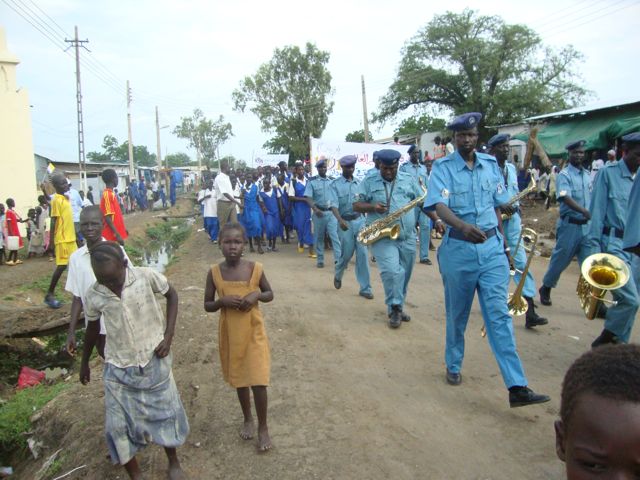
Police band


Malakal road after the wet


Br. Jorge hands new computer fo Br. Bill


Br. Heldon marching

Wednesday, October 13, 2010

Solidarity Unwanted - by Br. Bill Firman

50. Solidarity Unwanted


‘Solidarity’ is a great idea, standing together with the Sudanese people and journeying with them, and our fellow workers, toward our common goals. I am here as part of Solidarity with Southern Sudan (SSS). Our mission statement asserts our purpose: ‘Solidarity with Southern Sudan is a project that seeks to promote the Kingdom of God in partnership with the local church and the people of Sudan through the establishment and development of teacher and health training institutes and those pastoral services deemed most urgent.’


SSS is the combined response of more than 150 Superiors General of religious congregations to the plea for help made by the Catholic Bishops of Southern Sudan. This is the first time so many congregations, forming mixed communities from diverse religious institutes of men and women, have responded collaboratively to such pressing needs as faced by Southern Sudan after more than forty years of wars and oppression. Our presence here helps build confidence and hope. Our combined endeavours bring great resources generated by the considerable efforts not only of the eighteen women and five men currently living and working in Southern Sudan but by many others planning, supporting and fund-raising in other parts of the world and coordinated through our SSS Board and office in Rome.


The way forward is being found not only with the Bishops and people of Sudan but in forming cooperative partnerships with other contributing organisations, both government and non-government. What seems to be the single, greatest, peace initiative across Sudan is the 101 Days of Prayer Towards a Peaceful Referendum. It is encouraging to know so many people outside of Sudan are also supporting this focus on peace, the campaign started by one of our SSS sisters, Cathy Arata, a diminutive figure in size but not in spirit, who was also one of the key pioneers who brought about the existence of SSS in the first place and promoted the value of such solidarity.


Someone said to me recently in Malakal: ‘We are with you Bill in solidarity’. It was a quip about an unwanted solidarity we have recently experienced. We have had power surges and burn outs, the product of faulty work and equipment in this region where shoddy standards of workmanship are all too common. Now, not only my computer was out of action but so were the power adaptors of every other computer in our community as well as the adaptor on our satellite internet modem and router. On the same day that we awoke to these computer problems, our water supply from the Nile cut out and we had been waiting three weeks for a new supply of gas bottles to arrive from Khartoum. We were not out of gas as we have a reserve bottle which would normally last a month. A few days later our phone rechargers ceased to operate. We try to plan ahead and ‘be prepared’ but even surge protector power boards don’t prevent mishaps. Our internet provider in Juba told me that a high intensity flash of power can be so fast it gets past a protector before it can trip.


So what do we do? Respond to the issues one at a time, share and help one another where we can and learn to be more patient and grateful for what we still have. The gas did arrive, I have a new computer to use, albeit with many instructions in Italian and a keyboard with buttons not always doing what they indicate and I have found another way to charge my phone. I am now in Juba and today sent our restored internet equipment back to Malakal. It is good to be alive even when the technology on which we come to depend is temporarily ‘dead’.


- Br Bill


Will of people for peace


Watch your step


Through the town


Soldiers for peace


Observers


Muslim prayer


Gathered


Children marching


Bishop speaks


Beginning peace march


Wednesday, September 22, 2010

101 Days to Pray-Br. Bill Firman

49. 101 Days to Pray
Yesterday we marched – and marched. The normal ‘Murphy’s Law’ states that ‘Anything that can go wrong will go wrong’. There are two Sudanese variations: ‘Anything that can be delayed will be delayed’ .. and .. ‘Anything that can be changed will be changed.’ Both variations applied today. In Church on Sunday, one announcement said that our walk to launch the 101 Days of Prayer Towards a Peaceful Referendum would start at 8:00am, the other said 8:30am. We opted for 8:30am and prudently did not turn up until 8:50am. Actually we weren’t prudent enough as the walk did not actually begin until 9:30am – but I’m not really complaining as everyone was in good spirits and the cloud cover kept the temperature at a pleasant level.

The marchers walked happily and many onlookers came out to watch. The police band beat out a lively rhythm and after about half an hour the leaders turned at the designated spot to head for the so-called ‘Peace Square’ where there would be speeches. But suddenly we came to a halt and the parade was directed back to the road we had just left. The people marching from the other end of town had not arrived. So the sudden decision was made that we would walk on towards them. Inevitably the two walking groups met head on not far from the main market near the centre of town. Both groups stopped. Small problem there of where to go now! Eventually the other group wheeled around, the police band moved forward, the other group retreated whence they had come and our larger contingent followed.

This more than doubled the distance of the march but it did mean we passed through both end of the centre of the town. All this was achieved with great good humour and tolerance, even by the bemused vehicle and donkey cart drivers who were marooned amid a sea of people as the waves of walkers passed them by. The altered route turned out well as it focused very many people’s attention on the 21st September as the International Day of Peace and on the theme of praying for peace leading up to the referendum.

According to the programme, speeches were to begin at 9:30am and conclude by 11:30am. Yes there were a lot of speakers - sixteen - plus three lots of entertainment and both Christian and Muslim opening and closing prayers. Speeches began at 11:00am and finished at 2:00pm. What was most impressive, however, was the wholehearted support of the initiative by the whole community. One of our SSS members, Sister Cathy Arata, conceived this idea, and with the promised support of Catholic Relief Services, presented it to the Sudanese Bishops’ Conference. All Bishops agreed to implement it throughout Southern Sudan.

In Malakal, the Catholic organizers invited the involvement of the other Churches, including the Muslims, plus the Government - and all joined in enthusiastically. The Governor arrived with his military escort. It was a little ironic at this peace rally that there were many prominently placed armed soldiers in view, but this is Sudan and most people seem to take no notice of armed soldiers.

It may have been a long event but it was good to have been part of this great launch of the 101 Days Of Prayer For A Peaceful Referendum. What was also evident from the tone of the speeches was that the present mood is strongly towards separation from the north. The day was an encouraging expression of unity in the south. - Br Bill

Tuesday, September 14, 2010

The Priority is Peace-Br. Bill Firman

The photos show some of the poor people of Southern Sudan who are hoping and praying for continuing peace. Be with them in prayer, and in any other ways you can help them. If war comes, we can leave. They have nowhere else to go.

- Br Bill

48. The Priority is Peace

In January 2011, there is to be a referendum with Southern Sudanese voting for either a unified Sudan or secession. The referendum was brokered as a key factor in reaching the Comprehensive Peace Agreement (CPA) of 2005. In the South, the feeling is running strongly in favour of secession. My sympathy is with the poor people of Southern Sudan who have suffered for centuries from violence, slave trading and oppression. The south itself, however, has no real unity other than fractured opposition to the north. Secession could quite possibly lead to more inter-tribal violence and, maybe, anarchy. The president of the Sudan Catholic Bishops’ Conference, Bishop Rudolph Deng has cautioned:

“Many people do not realize that more southern Sudanese were killed by other southern Sudanese than were killed by those from the north.”

I fear that there is an unreal hope in the South that a vote for secession will deliver more prosperity, more opportunity, better education and health care. The agreement for the referendum came as part of the process of ending the long war. The priority then was to find a way to bring about peace. The priority now is to maintain the peace.

Whatever the result of the referendum, be it unity or division, it is what happens after the referendum that will be critical. The south depends heavily on Muslim traders for the supply of goods. That infrastructure is very important. If the vote is for secession, the south will still need the north as a good neighbour. Is the north prepared to be a good neighbour? Will the Arab traders in the south be able to continue to deliver their services with safety and security? We simply don’t know.

There is the abundant oil in the south but the refineries are in the north, Good cooperation between north and south will be essential, at least in the short term or both north and south will suffer. The danger is that the referendum be seen as a battle between north and south over assets such as oil. At present there is real progress and improvement in many areas. Every effort must be made to preserve the peace and for a time of healing, not hurting, to ensue.

The waters of the Nile are another key issue. Egypt favours unity as it does not want there to be yet another nation to negotiate with over water rights. The waters of the Nile are a precious asset. Disputed borders, and determining who should be eligible to vote, are further problems to be dealt with. A process of peaceful conciliation and arbitration, not violent intervention, is the only positive way forward in solving such issues.

A return to the horrors of war should be unthinkable but is, unfortunately, possible. Both sides have spent the years since the CPA was implemented in re-arming and being prepared for renewed hostilities. If war breaks out it will be far worse than before. Maintaining peace is the priority. Steve Hilbert, Africa specialist on the staff of the U.S. Catholic Bishops asserted:

“There are a million ways this can go wrong, and only one it can go right. Will we witness a new peace or a return to an old war?”

Many organizations, especially the Churches, are pleading for respect for different ethnicities and religious convictions, whether or not there be one Sudan, or two. Peace, reconciliation, respect for the rights of others and freedom of choice are the kind of values that this country needs in both north and south. September 21st is the International Day of Peace. It marks the beginning of a campaign for peace, the ‘101 Days of Prayer Towards a Peaceful Referendum in Sudan’, ending with the World Day of Peace, (January 1, 2011). Peace is the priority for the Sudan. Enduring peace is the only way there will be winners! Join us in praying for peace in all Sudan. - Br Bill


Child 1

Our World
Mother & Child
Keep life good
Give me a chance
Children
Children
Children
Children

Children

Monday, September 13, 2010

Potholes and Patience-Br. Bill Firman


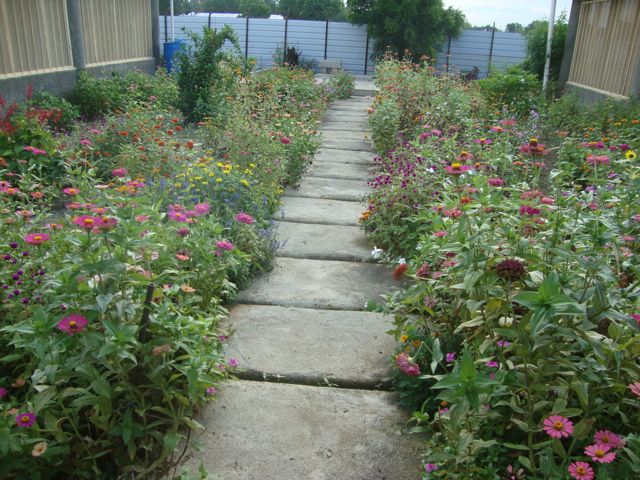
We were pleased to welcome Sr Luchita back to Malakal from Colombia. It is much cooler than when she left and the gardens have come alive with flowers. It is almost a year since I arrived and I have included two photos that show our gardens then and now after careful cultivating by some of our community members. The climate seem to me to be much more temperate than this time last year when I arrived – or maybe I have adapted. I’m not yet sure. Best wishes to all.

Br Bill

47. Potholes and Patience

As if the roads are not bad enough already, someone seems determined to turn them into an obstacle course. Roadside, drainage ditches have been deepened recently by an excavator. The soil was not removed but simply dumped on the edge of the roads making them narrower and muddier. Sometimes, major roads are randomly closed off for the excavator to work. There are no detour signs but one is just expected to find another way.

With the roadside so muddy, every person, dog, cow, pig, goat & duck chooses to join the donkey carts, horse carts, bikes, wheelbarrows (carrying water), cars and trucks in the centre of the road which tends to be firmer. No need to look first! If you get there first you have the right of way – so the reality seems. You may be coming from the opposite direction and overtaking on what I would call the ‘wrong side’ of the road, but why worry about that?

Even if I were younger, I wouldn’t be looking for a ride on the dodgem cars in a fun park. Here I can have it all for free - weaving and sliding in between pedestrians, carts, vehicles, animals and abundant children, not to mention pushbikes, motor bikes (no helmets required) and wheelbarrows. I have noticed it is easy for a pushbike rider to become unbalanced if the bike begins to wobble when there are five, 20 litre, plastic gerry cans of water tied on to it. Watch out for the sudden lurch, one learns!

When roads dry out they are rock hard and bumpy from all the furrows ploughed by vehicles during wet periods. When it rains, the roads first become very slippery and then begin to dissolve into deep slushy mud. Yesterday our vehicle had a flat tyre – fortunately it deflated while parked within our property. No obvious reason, except that we know there are all kinds of hazards hidden in the mud. With some difficulty, we removed the wheel as the car jack was pushing itself into the ground at the same time as elevating the vehicle. Action/reaction: Isaac Newton illustrated! It cost 10 Sudanese pounds (less than 4 dollars) to have the tyre repaired at a low tech, hand tools only, road-side stop. There is no high tech tyre change here as far as I know. Fortunately repairs were finished before some heavy rain fell and we are mobile again.

So far I have been lucky. Although I have driven down some very muddy roads and have come close to being stuck, I have each time managed to move on. Neither have I slipped into a ditch nor collided with anything or anyone. Fortunately, we never have far to travel and at times our speed is that of the walking donkey cart in front of us. It is also kind to pedestrians to drive slowly and not spatter them with mud! At one UN security briefing, attended by Sr Betty, the issue was raised that some drivers have been seen speeding at 40kph. 20kph is recommended.

There do not seem to be many accidents in Malakal – although I heard recently of one old man who suffered a broken leg when knocked down by a taxi. The people were angry, I was told. The simple expectation here is that vehicles do not collide with people or animals and you are in the wrong if you do. Most drivers are very careful – unlike in Juba where some drivers hurtle around in crazy fashion with the consequence that there are far more accidents. I prefer to edge my way around the potholes of Malakal and keep moving, albeit slowly!

One big positive is that we don’t get flooded as they have recently in Pakistan, China and my home state of Victoria, in Australia. Sometimes, especially when strong winds blow during a storm, water gets into our house. The floor, however, dries quickly. Malakal is flat and excess surface water flows into the Nile in deep drains while the many swampy puddles gradually evaporate or are absorbed into the soil. When the sun shines for half a day, the roads become much easier.

We do hope for firmer footing and fewer potholes but the pace of life is slow here. There is no need to hurry. Patiently coping with the potholes in our lives, both literally and metaphorically, is something we all must learn to do. Eventually, sun always follows the rain. - Br Bill


The Market
The main road
Sr. Luchita
Slippery
Outside the market
Now
Muddy road
Layer
Hazardous

12 months ago

Friday, September 10, 2010

Más de Uno-Sor Luz Enith Galarza Melo

Más de uno…

Han pasado dos meses de trabajo intensivo formando profesores de básica primaria, de acuerdo con el propósito y el programa de este hermoso proyecto llamado Solidaridad con el Sur de Sudan.

Hemos sumado más de ciento cincuenta horas en las aulas, bajo el intenso calor de la época más calurosa del año y lo mejor de todo. La posibilidad de conocer gente buena que esta interesada en prepararse para contribuir a la reconstrucción de este país luego de más de 20 años de cruentos conflictos. Ellos sienten y asumen esta responsabilidad como propia dado que perdieron mucho con la guerra, más aun, incluso sus vidas quedaron por reconstruirse, desde que en 2005 fue firmado un acuerdo de paz.

En nuestro balance, vamos acumulando historias, vivencias, aprendizajes y experiencias que las palabras no alcanzan a describir totalmente, dada su profunda y compleja relación con la esencia y el sentido de la vida misma.

Por estos días, aprovechando el descanso a la espera de iniciar una nueva etapa del proyecto. Me encuentro absorta en la lectura de un muy interesante libro cuyo titulo se traduce como: Jesús hoy. La espiritualidad de la libertad radical. Escrito en el 2006, por Albert Nolan, un sacerdote de la orden de los dominicos, procedente de Sur África.

Leerlo ha sido algo apasionante. Me refiero a que este libro es de aquellos que ofrece un amplia gama de ideas que inmediatamente logramos entrelazar con otras. Así como surgen los encuentros entre amigos que tienen una cita para departir una grata tertulia.

Una de estas ideas “amigo” es su planteamiento que el origen de los problemas del hombre actual se debe al individualismo, producto de la Revolución Industrial, desde cuando éste se centró en sus derechos, dejando en un segundo plano el bien común, de tal modo que la sociedad occidental industrializada comenzó a promover la autonomía individual en la cual no se requiere del otro sino para el sexo.

Autosuficiencia, que por supuesto necesita autofinanciarse, persiguiendo como objetivo adquirir un espacio propio. La independencia total, que redundará en la conquista de la libertad.

El autor propone un interesante análisis de este contexto desde diferentes perspectivas y compara esta propuesta con otras que se contraponen a ella. Como por ejemplo, la base cultural de muchas sociedades, como la africana para las cuales el ser humano sólo entiende desde su vinculación a la comunidad. Parafraseando una popular expresión local: “Una persona se convierte en persona a través de los otros”.

Aquí cobra un lugar importante el legado de los ancestros. Los cuales también parecen estar demás en la propuesta del ser individual. No se necesita una identidad definida cuando todos podemos diluirnos en aquella que esté a la orden del día, del momento y reemplazarla al poco tiempo por la nueva que vendrá.

No necesitamos minuciosos estudios para analizar los resultados, de la separación del ser humano de los demás y de sus raíces. Basta con mirar dos de los más grandes problemas que enfrenta el hombre de hoy: La soledad y el suicidio a causa de la ruptura de los vínculos afectivos, del desarraigo. El no pertenecer, el carecer de un “que” nos pertenezca.

Existe una fundación en mi país llamada Liga Colombiana contra el suicidio, que cuenta con profesionales que estudian para comprender y prevenir esta problemática que tristemente, aumenta en cifras vertiginosamente. Uno de sus estudios indica que quienes cuentan con redes afectivas grandes, cuyos vínculos son fuertes, están más lejos de sufrir depresión y de llegar a suicidarse. Claro esta, cuando el origen de esta dado por causas clínicas.

De la anterior tesis se deriva una consecuencia que corroboran los resultados de sus hallazgos. La felicidad esta directamente relacionada con la cantidad y la calidad de los vínculos afectivos que se posee. Una teoría bien interesante.

En la práctica, a lo largo de estos años, hemos sido testigo de diferentes fenómenos que no se pueden aislar de este contexto; dado que no nos ilustran propiamente el cómo el ser humano construye o fortalece sus redes afectivas. Me remitiré sólo a algunos hechos.

El centrarse en los “nuevos intereses” de las parejas en Europa redujo a un nivel preocupante y problemático el índice de natalidad. Una decisión de dos que convirtió en un fenómeno social con amplia e inusitada repercusión.

Sin mencionar los serios problemas ambientales, de los cuales también, ya sufrimos su impacto.

Los intereses individualistas en el nombre del desarrollo de unos pocos hace mucho tiempo que decidieron que el bien colectivo está por demás. Lo peor es que esos pocos son poderosos y no les conviene comprometerse con los acuerdos para preservar el planeta. A pesar de las cumbres internacionales. Copenhague, como triste ejemplo.

Sin embargo, en el lado completamente opuesto a esta realidad individualista, que no pretendo abarcar en todas sus consecuencias. Se presenta ante nosotros la experiencia comunitaria, de la cual somos testigos en nuestro día a día en Sudán y ésta es la segunda idea “amigo” que tiene una voz preponderante en esta reflexión.

A este lugar la corriente del individualismo está llegando pero no se ha instalado y reconforta la existencia, la posibilidad de mirar la otra cara del prisma.

En la vida sencilla de los sudaneses es posible palpar el sentido que le confieren a la comunidad en detalles simples y cotidianos, que como todo tienen un gran efecto. Contar con el otro es importante.

Por ejemplo si se va a tener una celebración o cualquier tipo de actividad se debe enterar a los vecinos. No necesariamente invitarlos, pero si tenerlos en cuenta. Comunicarles es una manera de hacerlos participes y en caso que durante el evento surja cualquier tipo de inconveniente, esto garantizará su ayuda. No en el caso contrario. Sino se les avisa no se tiene el derecho de reclamar su colaboración si esta es requerida.

Un ejemplo de otro aspecto relacionado con las celebraciones.

La pasada vigilia pascual duró cinco horas. Resaltando, que durante todo el tiempo la comunidad manifestó el gozo de celebrar unida a través de sus cantos, oraciones y danzas. Nadie se quejó ni se mostró incomodo. Los únicos que estamos pensando en el tiempo éramos nosotros, los foráneos. Quizá porque nos centramos en nuestro propio cansancio y cualquiera podría alegar diciendo que “no hay derecho”… derecho al bienestar individual por supuesto.

Todas las celebraciones a las cuales he tenido la oportunidad de asistir durante estos casi dos años se han caracterizado por estos dos aspectos, la cantidad de gente participando rebozante de entusiasmo durante largos periodos de tiempo.

El padre Notan refiere algo al respecto en su libro cuando hace alusión a las iglesias vacías en Europa y otros continentes, pero repletas en África.

Aquí converge toda mi reflexión. La comunidad resignifica, los acontecimientos, los paradigmas, la vida misma.

Bill Firman, un hermano de la Salle que comparte con nosotros esta misión; quien se caracteriza entre otras cosas, por su basta experiencia en el ámbito educativo. Coordina el proyecto en esta área, y el don de contemplar el día a día, extrayendo enseñanzas de vida, que luego escribe en un estilo muy propio. Trajo esta idea a mi tertulia, que sin dudarlo tiene mucho que aportar. Se trata del papel que juega la comunidad en la educación de los niños. Un echo muy palpable en todos los lugares de Sudan, que hasta el momento he tenido la oportunidad de conocer.

Los niños respetan y acatan a los mayores, porque estos a su vez, se responsabilizan de ellos en cualquier contexto. Especialmente las mujeres, desde niñas las más grandecitas atienden a los pequeños y luego cuando se convierten en madres, es como si ejercieran una maternidad colectiva. El rol que les concede la maternidad, ampliamente valorada en esta cultura, les otorga la potestad de ser acatadas por los niños; bueno y también por los adultos. Todos aquí obedecemos a las “mamas”, nombre con el cual se reconoce a quienes también se identifican por vestir una colorida manta que anudan en el hombro derecho, localmente llamada “Lao” .

Nos llama mucho la atención, la naturalidad con la cual este echo es asumido. En mi cultura. Cualquier madre protestaría si otras le prohíben a sus niños hablar en el templo o entrar y salir de el durante la Eucaristía, o instarles a ceder su asiento a los mayores, madres con bebes o minusvalidos; por citar solo dos ejemplos.

Quienes conocemos la vida de un colegio, sabemos que este es uno de los principales problemas.

Padres de familia que no consienten que se les diga nada a sus hijos, aún reconociendo el fondo que su comportamiento o su falta de responsabilidad les está afectando.

El educar, como otras tantas cosas dejó de ser una responsabilidad del colectivo. Se delega para que otros lo asuman: Uno de los padres, unidos o separados. Los maestros, pero casi que con un manual de instrucciones; en el caso que los padres se aparezcan por el colegio; los abuelos, en fin. No se aúnan esfuerzos. Siquiera en un consenso dentro de las propias instituciones. Lo que origina muchos problemas entre los que ejercen su misión de formadores y quienes no.

Considero que la comunidad es la clave olvidada o rezagada que permitiría afrontar muchos de los problemas que agobian a nuestra sociedad. Que puede sacar al hombre de la falsa idea que es posible alcanzar la felicidad y la libertad a base de egoísmo.

Estoy convencida que cualquier labor que realice tiene sentido si contribuye a la construcción de comunidades. Descubro que su esencia me sabe a Evangelio. Le apuesto a la construcción de modelos pedagógicos, basados en el componente comunitario, que propendan el bien común; que eduquen para el convivir en comunidad.

Finalmente, confió que sino llegamos a esta concienciación movidos por la lectura de los resultados del pasado. Nos mueva el instinto. Ya que de acuerdo a los estudios de los neurólogos. Le debemos el área mas desarrollada de nuestro cerebro, del hipotálamo, particularmente la “amígdala,” a las múltiples y complejas conexiones que surgieron en nuestra época primitiva, tras la imperiosa necesidad de asociarnos para cazar, para defender a las crías, para mostrarnos menos indefensos ante los depredadores, para sobrevivir.

Luz Enith Galarza Melo

Religiosa Filipense